Service
React.js
Developer
React.js remains the go-to library for building fast, maintainable interfaces. As a freelance React developer, I design high-performance front-end applications, paired with a Node.js backend when the project calls for it — a single point of contact, from component to API.

What I build in React.js
From a single component to a complete application, with constant attention paid to performance and accessibility.
React / Next.js web applications
Fast interfaces, reusable components, optimized rendering (SSR, SSG or CSR depending on the need). From landing page to full product with global state and protected routes.
SaaS dashboards & interfaces
Data-intensive dashboards, sortable/filterable tables, real-time charts, and role/permission management on the interface side.
Migration to React
Taking over an aging jQuery, Angular or WordPress front end and migrating it to React step by step, without interrupting production or starting from scratch.
API & Node.js backend integration
Connecting to an existing REST or GraphQL API, or building the Node.js backend alongside the front end. A single point of contact across the whole stack.
React stack I work with
A modern React ecosystem, chosen for its stability in production and its speed of iteration.


My methodology
Defining the screens, the component breakdown and the rendering strategy (SSR, SSG or CSR). Deliverable: a short brief and a firm quote.
Early development of the first components and key screen flows to validate the experience before rolling it out across the whole app.
Regular deliveries to a staging environment. You follow progress in real time and can adjust priorities along the way.
Optimized build, performance testing (Core Web Vitals), technical documentation and handover. Available for post-launch support.
Why a freelance React developer instead of an agency?
One point of contact, from component to API
No relay between project manager, designer and developer: I scope, I code and I ship. Fewer back-and-forths, faster decisions.
Readable code, no unnecessary dependencies
Component architecture built to last: no library added on a whim, no excessive coupling. Another developer can pick up the project without weeks of reverse-engineering.
SEO considered from the component architecture up
Rendering strategy (SSR/SSG depending on the need), metadata, Core Web Vitals — often overlooked on typical React stacks, built in here from the first line of code.
Dual front-end & back-end skill set
As a Node.js developer as well, I can take on the API consumed by your React components without bringing in a second provider.
React.js projects delivered
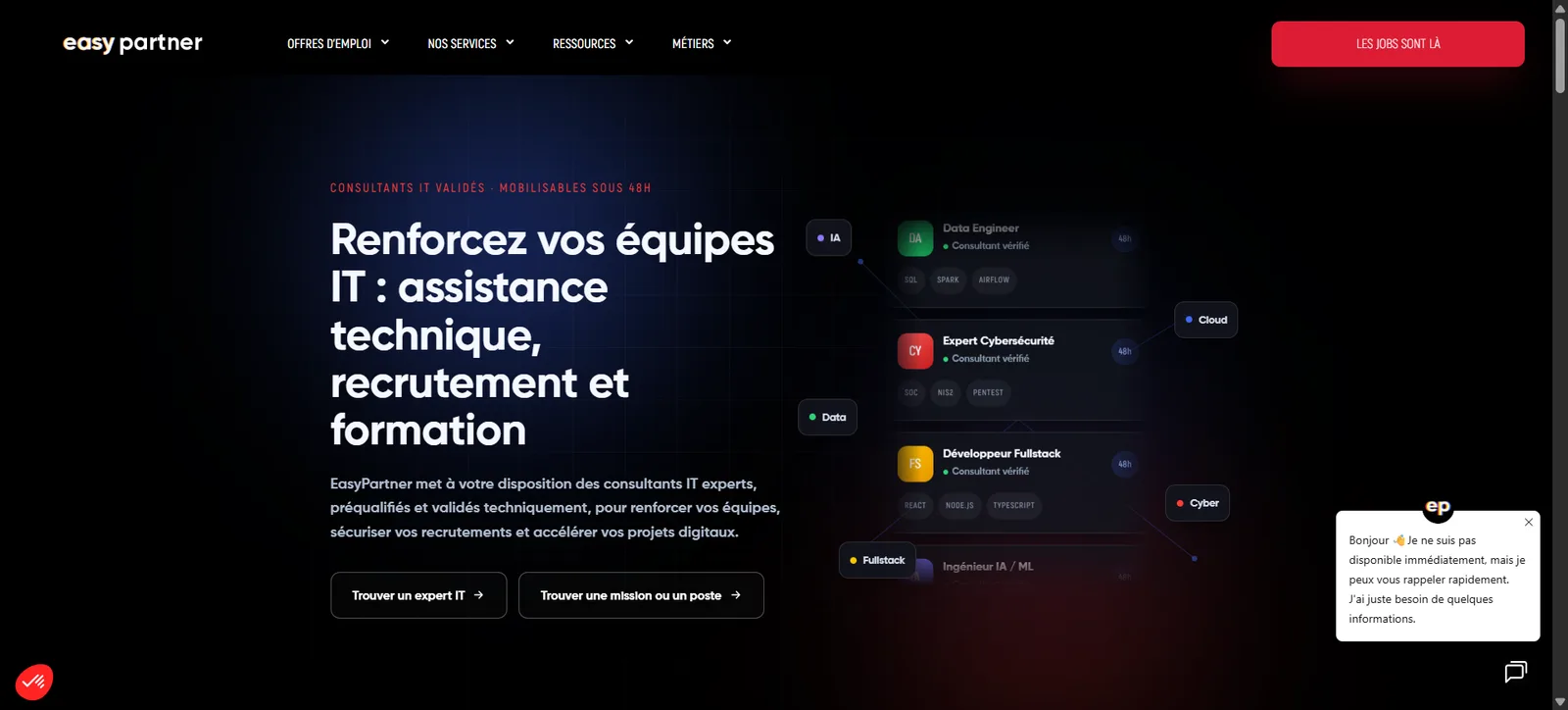
EasyPartner: WordPress/Elementor Rebuild and Custom HubSpot API Integration
A fullstack rebuild of a legacy WordPress site onto a maintainable Hello Elementor base, migration from the Bullhorn CRM to HubSpot, and a rebuilt SEO architecture (internal linking, keyword cannibalization).
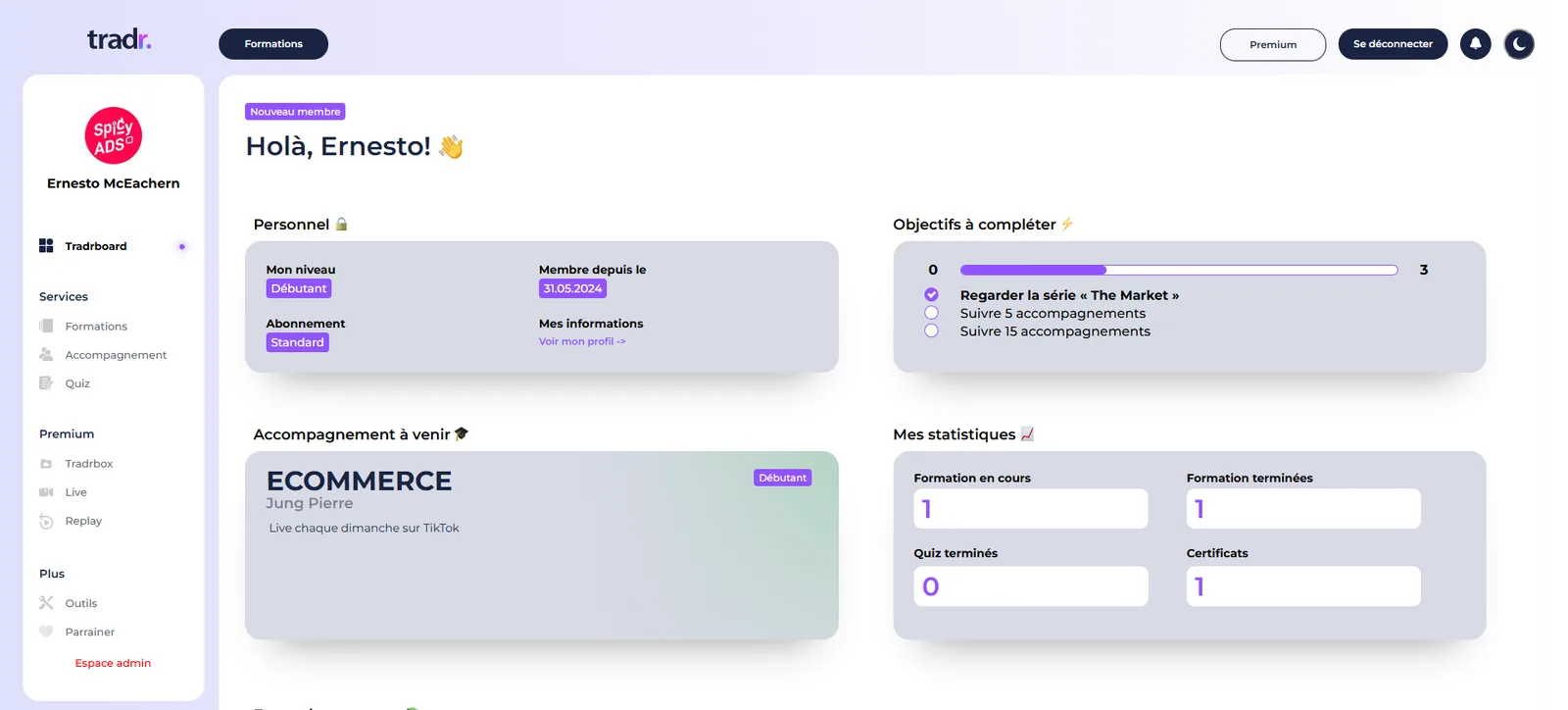
Tradr: Online Training SaaS, for Trainers and Participants
A multi-organization SaaS platform for online training management, bringing together a trainer space, a participant space, live coaching, quizzes and progress tracking in a single tool.
Frequently asked questions
What is a freelance React.js developer?
A freelance React.js developer is an independent professional specialized in the React JavaScript library, who designs and builds web interfaces without going through an agency. You talk directly to the person writing the component code — no technical project manager standing between your requirements and the implementation. For a React application, where architecture decisions (state management, component breakdown, rendering strategy) have a direct impact on long-term maintainability, speaking directly to the developer avoids the information loss that comes with intermediaries.
How long does it take to build a React.js application?
A dashboard or SaaS interface of average complexity (authentication, a few data views, forms) typically takes 3 to 6 weeks to build. A more ambitious application with complex global state, multiple roles and third-party integrations takes several weeks to a few months depending on how many iterations are needed. A landing page or showcase site in React/Next.js can be delivered in a few days to two weeks. The exact timeline always depends on the initial scoping — I don't give a firm estimate before seeing the brief.
Should I use Next.js or plain React for my project?
It depends on your rendering and SEO needs. Next.js is the right call if the content needs to be indexed by Google (showcase site, blog, e-commerce) thanks to SSR/SSG, or if you want built-in API routes without a separate backend. Plain React (with Vite) works well for an internal application, a dashboard behind authentication, or a business tool where SEO isn't a factor and client-side rendering is enough. This choice is made upfront, during scoping — reversing it mid-project gets expensive.
Can you take over an existing React application or migrate a project to React?
Yes. Taking over a project starts with an audit of the existing code and architecture: component structure, state management, outdated or poorly maintained dependencies. For a migration from jQuery, Angular or a classic WordPress front end, the preferred approach is progressive — replacing screens one at a time without interrupting production, rather than a risky full rewrite. The main point of attention is not breaking what already works during the transition.
Is a React application well-optimized for SEO?
Not by default — a purely client-side rendered (CSR) React application is historically poorly indexed, because the content only exists after the JavaScript has run. This is something I address from the architecture stage: SSR or SSG via Next.js when content needs to be visible to Google, metadata and structured data configured component by component, Core Web Vitals monitored from day one of development. For a purely internal application (authenticated dashboard), SEO simply isn't a concern — the distinction is made during scoping.
Can you also build the backend (API) for my React application?
Yes, I also develop in Node.js — see the dedicated Node.js developer page. For a project that needs both a React front end and a backend, that means a single point of contact across the whole stack, an API contract defined and honored on both sides, and no gap between two providers who don't always coordinate well on data formats or error cases.
Other services
A React project to build?
Describe your project, I'll get back to you within 24h with an estimate.