Service
Custom
SaaS
As a custom SaaS developer, I design and build complete applications from idea to production: multi-tenant architecture, authentication, dashboard, API and payments, with an AI layer built in if your use case calls for it. One fullstack developer, from the backend to the interface.
Real example Didaxo — a business SaaS for training providers: Qualiopi compliance, OPCO files generated automatically, Stripe billing. See the case study →What I can handle for you
From the technical foundation to the user interface, I cover every component of a SaaS application — without relying on a five-person team.
Multi-tenant SaaS application
Multi-tenant architecture with complete per-client data isolation. Workspace management, automated onboarding, quotas and plan-based limits. Built to scale from the very first subscriber.
Authentication & security
Robust authentication systems: JWT, OAuth 2.0 (Google, GitHub), two-factor authentication (TOTP), session management. Role-based access control (RBAC), activity logs, GDPR compliance.
Dashboard & backoffice
Custom admin interfaces: dashboards with real-time metrics, user management, advanced settings, data exports. Design consistent with your product's identity.
API & third-party integrations
Documented REST API (OpenAPI/Swagger), webhooks, Stripe or LemonSqueezy payment integrations, transactional emails, CRM, analytics. Every integration tested and versioned.
AI integration (optional)
When the use case justifies it: chatbot or contextual assistant via the Claude/OpenAI API, automatic content generation or classification, semantic search. Added on top of the SaaS without complicating the core technical foundation.
Technologies I use
A proven stack for modern SaaS products — performant, maintainable and ready to scale.


My methodology
Defining the core features, choosing the stack, modeling the database and user flows. Deliverable: short technical specs and a costed estimate per module.
Regular deployments to an accessible staging environment. Each sprint ships testable features — auth, dashboard, API — with feedback folded in before moving to the next.
Connecting third-party services: Stripe for billing, Resend for emails, OAuth for social login. Every integration tested in sandbox mode before going live.
Going live on a VPS or the cloud (Vercel, Railway, DigitalOcean), CI/CD setup, error monitoring. Technical documentation and availability for post-launch evolution.
SaaS projects delivered
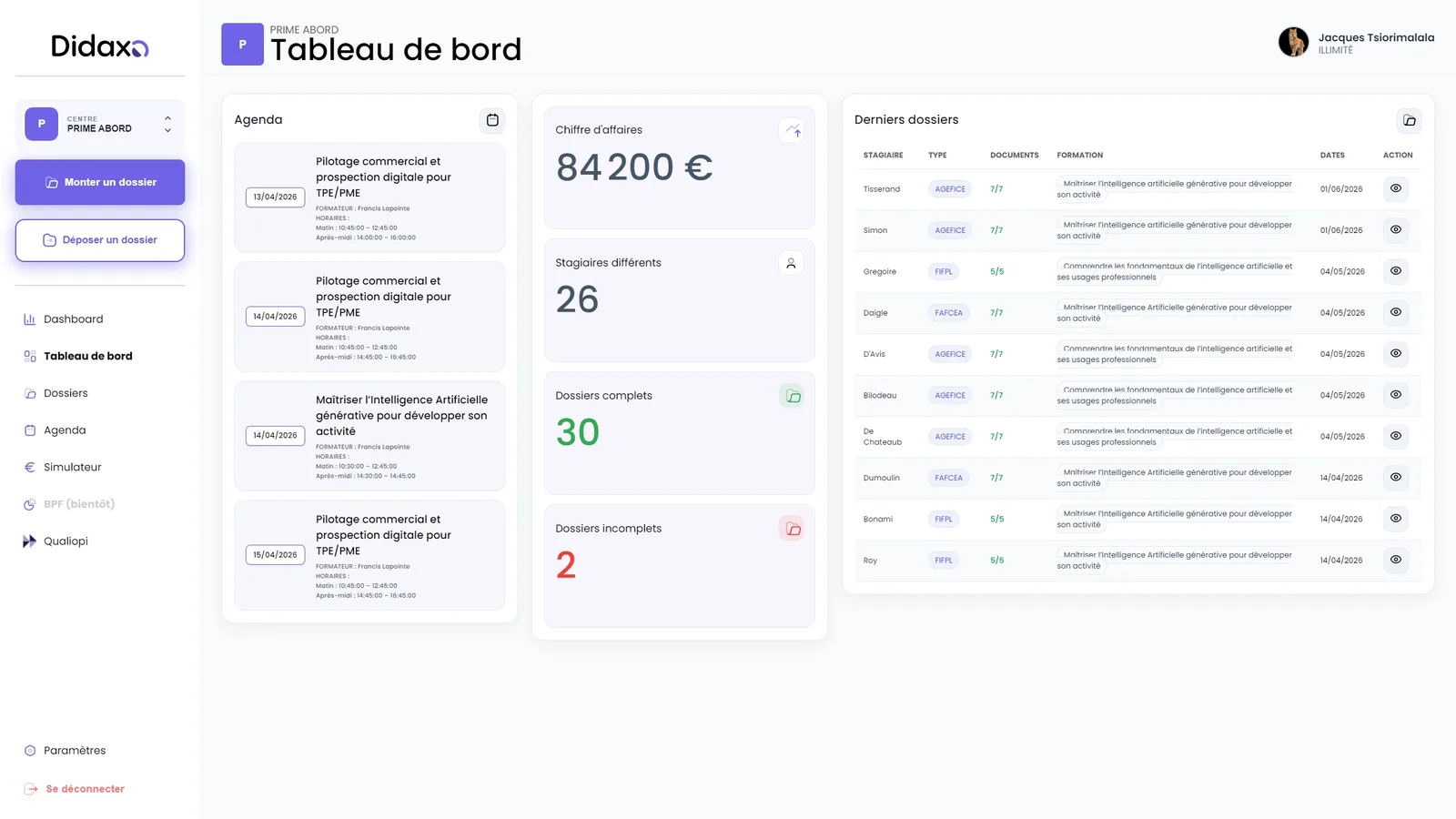
Didaxo: Fullstack Development of a SaaS for Training Providers
A business SaaS for professional training providers: Qualiopi compliance, automated OPCO funding files, the annual BPF report, and Stripe billing, all in a single platform.
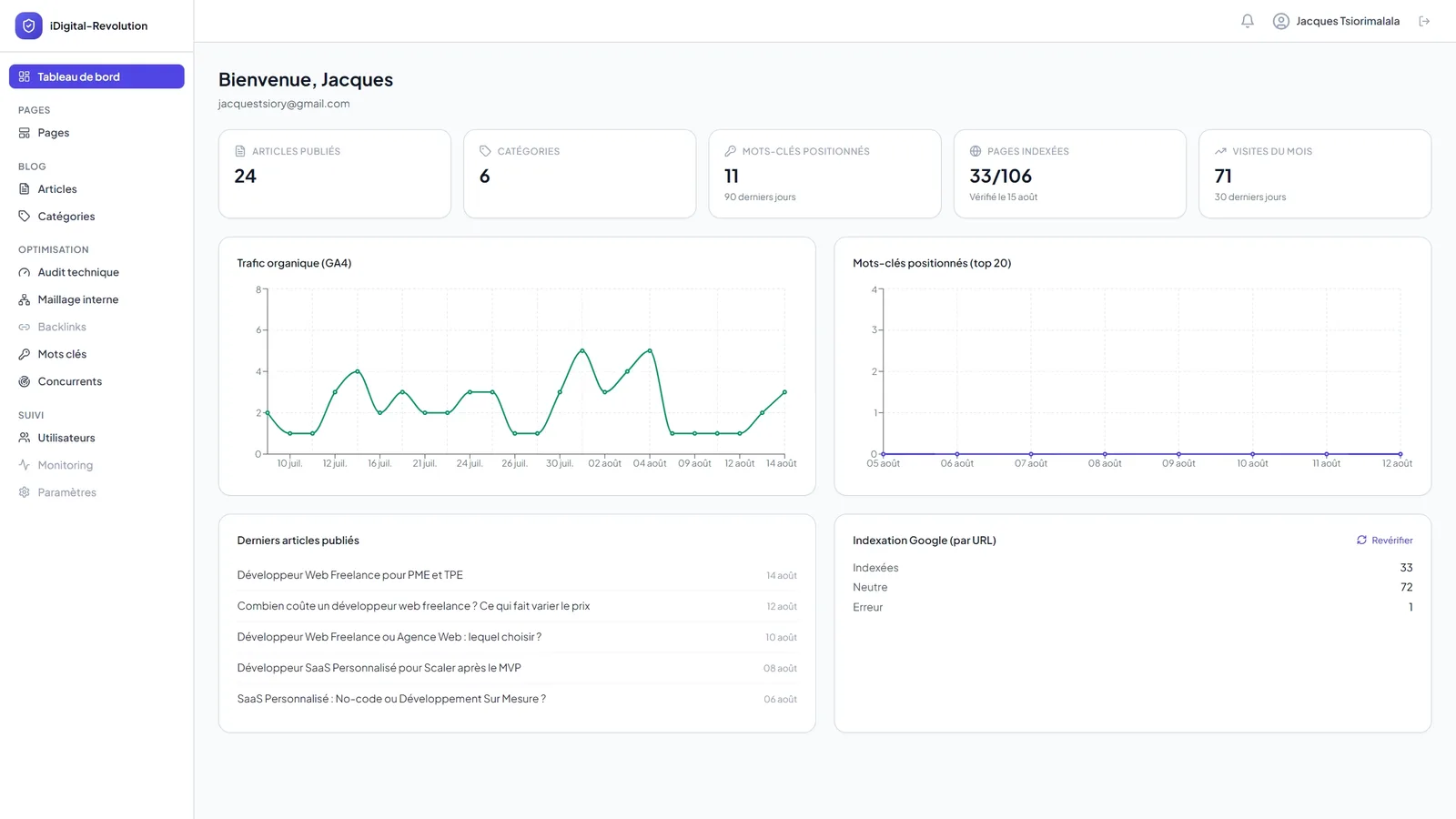
Portfolio Back Office: Custom CMS and SEO Command Center
A custom-built back office combining content management and real-time SEO tracking: SEO score, Search Console data, indexation inspection, competitor monitoring and internal linking, all in one interface.
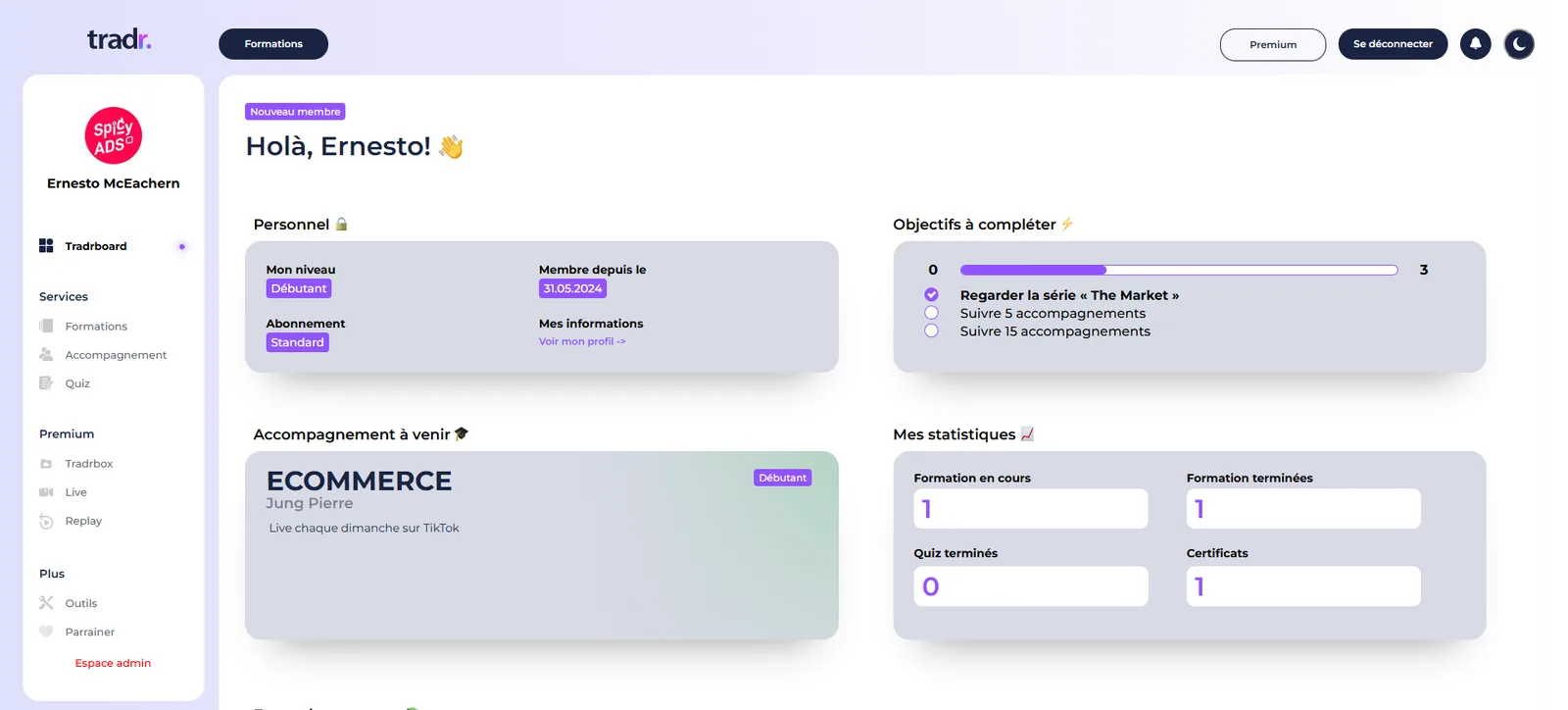
Tradr: Online Training SaaS, for Trainers and Participants
A multi-organization SaaS platform for online training management, bringing together a trainer space, a participant space, live coaching, quizzes and progress tracking in a single tool.
Why trust me with your SaaS project?
Architecture built to scale
From your very first customer, the architecture is designed to welcome the next ones without a rebuild. Multi-tenancy, data isolation, quota management — the solid foundations that avoid rewriting everything at 500 users.
Zero technical debt at launch
Readable, typed, documented code, tested on the critical functions. No excessive coupling, no superfluous dependencies. You can bring in another developer at any point without months of untangling.
SEO & performance built in
SEO-optimized marketing pages, monitored Core Web Vitals, structured Schema.org metadata. The SaaS I deliver is visible on Google from day one, with no extra editorial rebuild needed.
AI-assisted for faster delivery
I use artificial intelligence at every stage of development — boilerplate code generation, logic review, automated tests. A multi-module project delivered in weeks, not months.
Frequently asked questions
What is multi-tenant SaaS and why does it matter?
A multi-tenant SaaS is an application where multiple clients (tenants) share the same application infrastructure while their data stays completely isolated from one another — each client feels like they have their own dedicated tool, even though the code and servers are shared. It's the standard model for a SaaS product meant to serve multiple clients, as opposed to a custom application built for a single client. The benefit: infrastructure and maintenance costs are spread across all clients rather than duplicated for each one, which makes the model economically viable from the first subscribers onward. Designing this isolation from the start avoids a costly rebuild later, once the number of users grows.
How long does it take to build a full SaaS product?
It depends directly on the number of modules and how complex they are. An MVP with authentication, a basic dashboard and one core feature can ship in a few weeks. A more complete product with Stripe billing, role management, an API and third-party integrations generally takes several months, built in iterations with regular deployments to a staging environment rather than one single delivery at the end. The sprint-based approach lets each feature be tested as it's built and priorities adjusted along the way, instead of discovering a mismatch with the real need after months of building blind.
What's the difference between a custom SaaS and a no-code solution?
A no-code solution (Bubble, Softr, etc.) lets you launch a first prototype quickly without writing code, with lower upfront costs — but it locks you into the platform's technical and pricing limits, and it often becomes a bottleneck once the product needs to handle complex business logic, heavy load, or specific integrations. A custom SaaS takes more time and budget upfront, but gives you full control over architecture, performance and scalability — without depending on a third party's technical choices or pricing changes. The right choice depends on the project's stage: validating an idea quickly favors no-code, building a product meant to last favors custom development.
How does billing and payments (Stripe) work?
The Stripe integration covers recurring subscriptions with multiple pricing tiers, usage-based billing if your model calls for it, free trial management, and webhooks that automatically sync subscription status inside your application (access granted, suspended on failed payment, etc.). Every integration is tested in sandbox mode before going live, to check every scenario — successful payment, failed payment, refund, plan change — before a real customer is affected.
Will the SaaS be able to scale if my user base grows quickly?
That's exactly the point of thinking through the multi-tenant architecture and database structure at the initial scoping stage, rather than discovering the need urgently afterward. Data isolation per client, quota management, optimized queries and the right hosting choices (VPS or cloud with horizontal scaling) are set from the start. That doesn't rule out infrastructure adjustments as real growth happens, but it avoids having to rewrite everything the moment load finally increases — the worst possible time to start a rebuild.
Do I absolutely need to integrate AI into my SaaS?
No. AI integration (chatbot, content generation or classification, semantic search) is an option added only when the use case genuinely justifies it, not a marketing checkbox bolted onto every project. A solid SaaS without AI is still a solid SaaS — adding it only makes sense if it solves a real user problem, and it's designed to plug in without complicating the core technical foundation, not to become a fragile central dependency.
What happens after launch — who maintains the SaaS?
Deployment includes CI/CD setup and error monitoring to catch issues quickly after going live. After that, I stay available for post-launch evolution — new features, fixes, adjustments based on early user feedback. The project is also delivered with technical documentation, so you're never stuck if you decide to bring in another developer down the line.
Other services
Have a SaaS idea to bring to life?
Describe your project. I'll come back within 24h with an architecture and an estimate.